Once the frost hits, the soaker hose is usually the last thing still lying in the garden. It's stapled down and buried in mulch, and pulling it out seems like more work than it should be. So can you just leave it there?
The short answer
Sometimes, yes. But it has to be disconnected and drained, and the small parts have to come inside. What hurts a soaker hose over winter isn't the cold. It's water trapped inside the hose and fittings that freezes, expands, and splits them. Months of sun and freeze-thaw cycles also wear the hose out faster.
In mild-winter areas, a drained hose left under a good layer of mulch often comes through fine. Where the ground freezes hard, the safest option is to pull the hose, drain it, and store it inside. University extension services lean that way too. Missouri Extension warns that hoses left in the garden all winter usually degrade badly enough to need replacing.
Here's how to decide, and how to do either one right.
What actually damages a soaker hose in winter
- Trapped water. Water expands as it freezes. If it's sitting in a low spot in the hose, a fitting, or a valve, it can bulge or crack it. Fittings and valves usually go first.
- Freeze-thaw cycles. Wide temperature swings make hose material age faster, even when it's fully drained. Oregon State Extension notes that hoses left outside age faster and may only last a few seasons.
- Moving it while frozen. A frozen hose gets brittle. Oklahoma State Extension advises that if your hose froze before you got to it, leave it where it is and wait for a thaw before you drain and move it.
- Shovels and forks. Plenty of buried soaker hoses are lost to a spring garden fork, not to winter.
Should you leave it or bring it in?
Leaving it in place can make sense if:
- Your winters are mild, or the ground rarely freezes deep
- The bed won't be dug, tilled, or planted over the winter
- The hose is already pinned and mulched where you'll want it next year
Bring it in if:
- You get a hard freeze or long cold stretches
- You'll till or rework that bed before spring
- The hose is getting old or brittle, or has already been patched
When in doubt, bring it in. An afternoon of work costs less than new hose in April.
How to winterize a soaker hose you're bringing inside
- Shut off the water and disconnect at the spigot. Take off the spigot connector, along with any timer, pressure regulator, or filter. Store those somewhere that stays above freezing.
- Open the ends. Take off the end caps so water has somewhere to go.
- Drain it. Lift the hose a section at a time and walk it toward the open end so gravity pushes the water out. Watch for low spots and dips, which hold water.
- Pull the staples. Work them out gently so you don't tear the hose. Galvanized staples can be reused, so keep them in a bucket for spring.
- Let it dry, then coil it loosely so it doesn't kink.
- Store it out of the weather. A shed, barn, or garage shelf works. Keep it out of direct sun and off the floor where mice nest.
- Bag the fittings so they don't get lost.
How to leave a soaker hose under mulch for winter
- Disconnect it and drain it anyway. Never leave a soaker hose hooked to the spigot over winter. Take off the end caps, let the line drain, then loosely put the caps back on so soil and bugs stay out.
- Bring in anything with moving parts. Valves, timers, and spigot connectors should come inside. Fittings left in the line should be drained, and check them for cracks in spring.
- Keep it pinned and mulched. A few inches of mulch such as straw, shredded leaves, or wood chips protects the hose from sun and the worst temperature swings. Make sure it's still pinned so frost heave and critters don't drag it out of place.
- Mark where it runs. Push a stake or plant tag in at each end and at the turns.
Getting it ready for spring
- Reconnect at the spigot and run water at low pressure. Eaton Brothers recommends using a pressure regulator with their soaker hose, since it's built to work at low pressure.
- Walk the whole line. Look for spraying or dry stretches, and for leaks at the fittings.
- Open the end cap and flush it for a minute or two to push out any grit that got in over winter.
- Cut out any damaged section and splice the hose back together with a coupling.
Fall is also a good time to count what you'll need, so you're not waiting on parts at planting time.
About the hose we carry
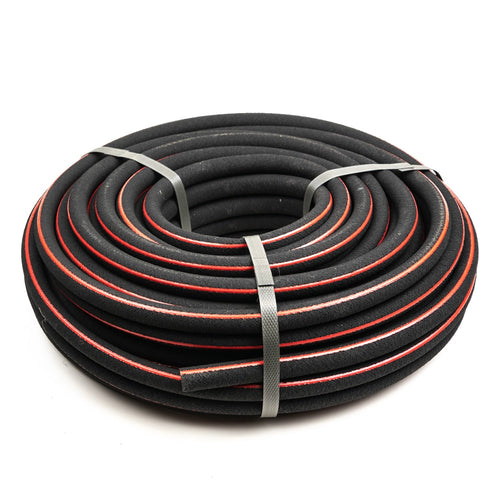
Our 1/2 Inch Bulk Soaker Hose is from Eaton Brothers. It comes in 100, 250, and 500 foot lengths with no fittings attached, so you cut it to fit your beds. Eaton Brothers rates it at about 142 gallons per hour per 100 feet at 25 psi. They recommend runs of no more than 150 feet, no more than 500 feet total off one spigot, and fairly level ground.
Because it's bulk hose, you build the layout with 1/2 Inch Soaker Hose Fittings: spigot connectors, couplings, tees, elbows, end caps, and an inline valve. They're push-fit and internally barbed, made from UV- and heat-resistant plastic, and work best around 15 psi.
To keep everything where you laid it, Landscape Staples are made in the USA from galvanized steel, so they resist rust and can be reused year after year. They come in 4-, 6-, and 12-inch sizes; the longer ones hold better in loose or sandy ground.
FAQ
Can you leave a soaker hose connected to the spigot in winter?
No. Disconnect it and drain it before the first hard freeze. Water left in the connector or spigot can freeze and crack them.
Can I leave my soaker hose under mulch all winter?
In mild climates, often yes, if it's drained and the valves and connectors are inside. Mulch protects it from sun and temperature swings. In hard-freeze areas it'll last longer stored indoors.
My soaker hose froze before I got to it. What now?
Leave it alone until it thaws. Moving or coiling a frozen hose can crack it. Once it thaws, drain it and store it.
Do I need to blow out a soaker hose with air?
Usually not. For most garden layouts, lifting the hose and letting it drain is enough. If you do use compressed air, keep the pressure low. Too much pressure can damage soaker hose and fittings.
What you need
Everything in this guide is in our Soaker Hose & Fittings collection and Garden collection:
- 1/2 Inch Bulk Soaker Hose for repairing or expanding your layout
- 1/2 Inch Soaker Hose Fittings for end caps, couplings, and spigot connectors
- Landscape Staples for holding hose in place under mulch
An afternoon of draining this fall means your watering is ready to go next spring.